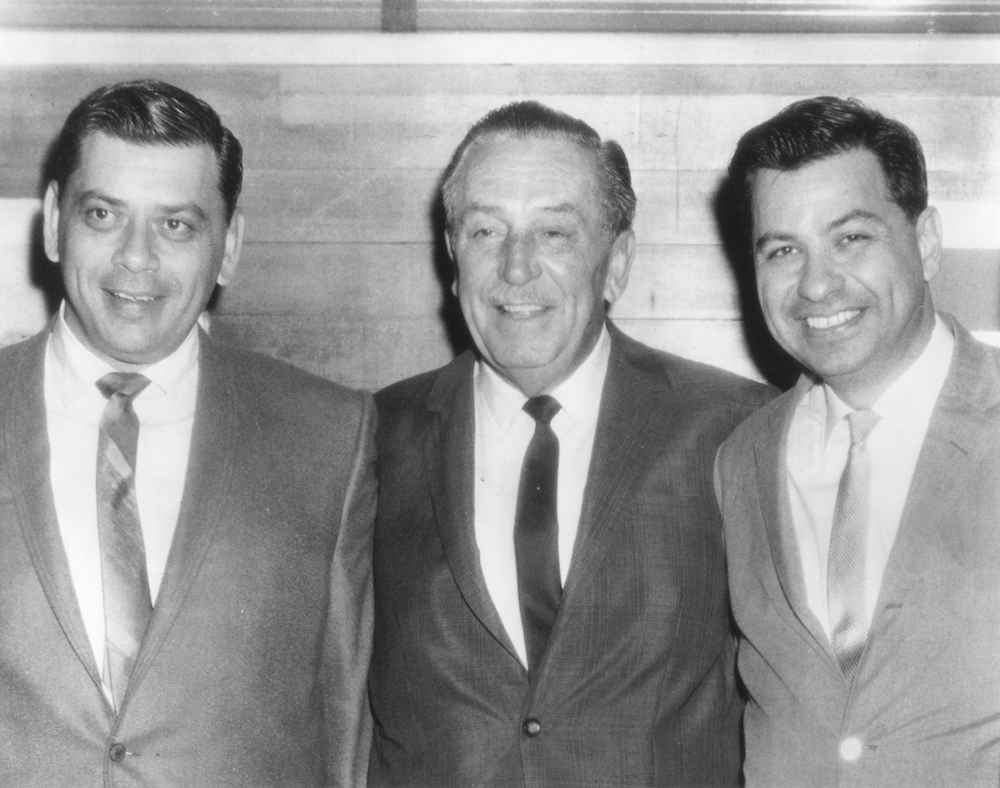
The death earlier this year of Academy Award-winning songwriter Richard (Dick) Sherman marks the passing of an era. He may have been the last major figure still living who worked closely with Walt Disney, especially on Disney’s live-action productions.
Richard and his brother Robert (Bob) formed one of the all-time great songwriting teams in the history of Hollywood. Best known for their work on Disney’s 1964 film Mary Poppins (for which they won two Academy Awards), the duo earned seven additional Academy Award nominations for other films as well as many additional awards. Their career continued after Disney’s death with non-Disney musicals such as Chitty Chitty Bang Bang (1968).
I had the privilege of interviewing the Sherman brothers while doing research for what ultimately became my book Walt Disney and Live Action. I was in my twenties at the time and attending grad school. They invited me over to their studio/office in West Hollywood one morning and regaled me with stories from their time working at Disney. Later, they graciously endorsed the first edition of my book, which came out in 1994. After it was published and I sent them two copies, they wrote me a congratulatory letter, signing it “with many thanks, your friends and admirers.” I’m sure they were equally encouraging to countless others over the course of their career. But as a young man starting on his career, their kindness made quite an impression on me.
As did a follow-up conversation I had with Richard Sherman after my original interview with him and his brother.
I’ve wanted to share about that subsequent interaction with Richard Sherman for some time. But I didn’t think was appropriate while he and his brother were still living. The conversation took on added poignancy in recent years for reasons I will explain.
In public, the Sherman brothers were the cheerful, ever-collegial songwriters who worked for Walt Disney. In reality, the brothers were somewhat estranged from each other in their personal lives. That rather painful revelation was disclosed in The Boys (2009), a wonderful yet bittersweet documentary about their lives and career created by two of their sons. I think for many who had met them, including me, it was a shock to learn of their private tensions.
I guess it shouldn’t have been such a shock. Richard and Robert had very different temperaments and life experiences. Robert, the older brother, was wounded and awarded a Purple Heart during World II, and he led the first Allied troops into the Dachau death camp. “In half an hour I saw enough to fill my nightmares for the remainder of my life,” he wrote later. Richard, being younger, was spared that trauma. He was more exuberant and talkative than Robert, and so he tended to dominate interviews.
In his posthumously published autobiography, Robert reflected on the challenges of working so closely with his younger brother: “It’s a difficult thing to be tethered for life to one’s brother. Both Dick and I would agree on this… the constant state of being ‘joined at the hip’ has been difficult for both of us. We’re very different people, with very different values, working together so intimately.”
Robert expressed in particular how challenging it was to participate in interviews with Richard. “He has a tendency to think that he is the only one with anything to say during an interview, so in order to get anything at all, I have to interrupt him. Then he interrupts me; or worse, he’ll repeat what I just said as though I said it incorrectly. Being interviewed in tandem with my brother is an annoying and frustrating process.”
Despite the strain, Robert acknowledged a deep familial love: “It is a testament to my brother’s and my love for each other that we’re able to manage working together.” Robert also made clear that he admired Richard: “I consider my brother to be a truly talented, gifted man. Any collaborator would count it a privilege to work with him.”
Learning out about the brothers’ strained personal relationship gave new meaning to a conversation I had had with Richard years earlier.
After I drafted the sections of my book where the Shermans were discussed, I sent them the sections to review for accuracy. Some days later, Richard and I had a long phone call. He was very positive about what I wrote. But he quietly asked me whether I would do something for him. He was concerned that he had dominated the interview, and he noted that I had quoted him more than his brother. He stressed that he and his brother were a team and he wanted my book to reflect that fact. So he asked me if I would attribute some of his quotes to his brother so they would come across more equally in what I wrote.
I agreed. I didn’t fully understand the request at the time, but it was clear to me that Richard loved his brother, and despite his natural exuberance, he felt bad about crowding his brother out of the spotlight.
At one level, it was a little thing. But little things matter. That was the message of Richard and Robert’s own song “Feed the Birds” in Mary Poppins, where an elderly woman asks for tuppence so she can feed the pigeons outside St. Paul’s Cathedral in London so they won’t starve. “The point of the song—that it doesn’t take much to give a little kindness—was what really registered with Walt,” the Shermans told me.
I attribute that quote to Robert in my book, but without going back to the original microcassette recordings, I’m not sure anymore whether Richard or Robert said it.
It doesn’t really matter. As Richard told me, he and his brother were a team, at least in their professional life. I think the sentiment reflected the views of both of them.
Richard M. Sherman (1928-2024) and Robert B. Sherman (1925-2012). May they rest in peace.
A Coda: Some Favorite Sherman Songs
When most people think of the Sherman brothers, they probably remember bright and perky children’s songs like “A Spoonful of Sugar,” “Supercalifragilisticexpialidocious,” and “It’s a Small World,” or perhaps their wistful “Chim Chim-Cheree.” But the Shermans’ output was vast, and so was the span of songs they could write. They produced successful pop songs in the early days of rock and roll, including “Tall Paul” for Annette Funicello, “Let’s Get Together” for Hayley Mills, and “The Monkey’s Uncle” for Annette and the Beach Boys. They wrote love songs, including “About Time,” “For Now, For Always,” and “Are We Dancing?”. They wrote sad and meditative songs like “My Own Home” and “Hushabye Mountain.” They wrote folk songs, such as “On the Front Porch” for Burl Ives, which was one of their favorites. They wrote stirring songs of Americana like “Dakota.” They wrote wonderfully satiric songs such as “Sister Suffragette” and “Feminity.” Even their most light and bouncy compositions could make serious points. “I’ll Always Be Irish” is a witty exploration of how people can retain their ethnic identities even while becoming fully American. American citizenship is based on a commitment to a set of common principles, not on a common ethnicity.
Richard Sherman continued to compose songs after the death of his brother. His very last song for a film was a lullaby for an animated short film titled Mushka, set in Russia. It was a beautiful song on which to end, and it evoked Sherman’s own ancestral roots. His grandfather was a violinist who fled anti-Jewish pogroms in Kyiv (then part of the Russian Empire, now part of Ukraine.)
 Walt Disney and Live Action